

Showing posts with label portrait. Show all posts
Showing posts with label portrait. Show all posts
Friday, 23 December 2016


Wednesday, 12 October 2016

Tuesday, 5 January 2016

Tuesday, 23 June 2015

Sunday, 21 June 2015
BP Portrait Award: where are the “Rembrandts”?
The BP Portrait Award is an annual portraiture competition held at the National Portrait Gallery in London, England. "BP" stands for "British petroleum" now "BP plc", one of the world's six "supermajor" oil and gas companies.
A recent Guardian's article Sad face: doom and gloom at the 2015 BP portrait award by Jonathan Jones. says:
I agree with these comments. Being an artist myself, immensely inspired by a Rembrandt (I am from Belgium a country which was in Rembrandt’s times part of the same “geographic entity” and cultural tradition) and having attempted to modestly be selected to the BP National portrait Gallery award,
I however differ with Jonathan Jones’s analysis as to why there are “no Rembrandts” any more… He says “the BP portrait award is that it does not attract the best painters around.” The reality is that the BP National portrait Gallery award jury does not (pre-) select artists based on real talents. Each time I look at the selected portraits, I am puzzled and wonder why and how?
I agree that these portraits and faces look very gloomy every year I tried to participate to the competition. My strategy was probably doomed as I submitted happy portraits such as this one in 2007:


More intriguingly, I am almost not impressed by their technique, skills and ability to convey (not) somebody’s soul and emotions via this medium called painting.
In my view, art is about conveying and sharing emotions, or it is not art. This is why I am a great fan of Rembrandt: emotions are “communicated”, hundred of years later, thanks to his unique skills. I also try to share with Rembrandt joyful and daring personality. None of these characteristics are seen among the BP National portrait Gallery award selected artists.
Don’t blame the artists! I know there are contemporary “Rembrandts” out there. I blame the selection committee’s biased blindness. If the selected portraits look gloomy and sad, this is because they reflect the jury itself.
I am more optimistic than the jury and know there are "striving Rembrandts" out there.
When I learned that Kate Middleton official portrait was commissioned to Emsley, a BP 2007 winner the same year I submitted my smiling friend's portrait (see above) and when I saw his result (and the outcry in the country) I felt I had to give it a go. This was one of the reasons I decided to do my “own” Kate Middleton portrait, being selected for the BP award or not. This country is still free after all!
My "Kate Middleton" was done in a rush therefore her outfit looks unfinished. There are two reasons to this:

In a way my portrait of Kate Middleton is “unfinished”… on purpose because she was and still is an “unknown”.
Rembrandt's latest portraits such as this one look "unfinished" too. He probably would never been selected to the BP award today. I am happy to share this with him ;) lol.
ps: it is without saying I will never submit any of my portraits to the BP award again.
 |
| Rembrandt's laughing self portrait as Democritus. |
The best portrait painters capture emotion, but there aren’t any Rembrandts in this competition – just a lot of badly daubed tattoos and very serious expressions.Jonathan Jones writes on art for the Guardian and was on the jury for the 2009 Turner prize. He had these interesting comments on the BP National portrait Gallery award:
The best portrait painters capture emotion, but there aren’t any Rembrandts in this competition – just a lot of badly daubed tattoos and very serious expressions. […] Why should I care about all these people? The sheer battering misery of it all produces callousness and cynicism. Too much po-faced portraiture makes a stone of the heart. This is because art is not a simple conduit of feeling. Only in the hands of a Rembrandt can the brush directly communicate the soul’s truth. The reality of the BP portrait award is that it does not attract the best painters around, but instead is a magnet for mediocrity. This leaves the judges with an impossible task – I know, I have been a judge myself – of trying to find meaning in what are really very uninspired daubs.
From Sad face: doom and gloom at the 2015 BP portrait award
I agree with these comments. Being an artist myself, immensely inspired by a Rembrandt (I am from Belgium a country which was in Rembrandt’s times part of the same “geographic entity” and cultural tradition) and having attempted to modestly be selected to the BP National portrait Gallery award,
I however differ with Jonathan Jones’s analysis as to why there are “no Rembrandts” any more… He says “the BP portrait award is that it does not attract the best painters around.” The reality is that the BP National portrait Gallery award jury does not (pre-) select artists based on real talents. Each time I look at the selected portraits, I am puzzled and wonder why and how?
I agree that these portraits and faces look very gloomy every year I tried to participate to the competition. My strategy was probably doomed as I submitted happy portraits such as this one in 2007:

These portraits were shortlisted that year:


More intriguingly, I am almost not impressed by their technique, skills and ability to convey (not) somebody’s soul and emotions via this medium called painting.
In my view, art is about conveying and sharing emotions, or it is not art. This is why I am a great fan of Rembrandt: emotions are “communicated”, hundred of years later, thanks to his unique skills. I also try to share with Rembrandt joyful and daring personality. None of these characteristics are seen among the BP National portrait Gallery award selected artists.
I am more optimistic than the jury and know there are "striving Rembrandts" out there.
When I learned that Kate Middleton official portrait was commissioned to Emsley, a BP 2007 winner the same year I submitted my smiling friend's portrait (see above) and when I saw his result (and the outcry in the country) I felt I had to give it a go. This was one of the reasons I decided to do my “own” Kate Middleton portrait, being selected for the BP award or not. This country is still free after all!
My "Kate Middleton" was done in a rush therefore her outfit looks unfinished. There are two reasons to this:
- lack of time (ie money)
- being a Republican I chose to focus on her face/ personality rather than on her official outfit.

In a way my portrait of Kate Middleton is “unfinished”… on purpose because she was and still is an “unknown”.
Rembrandt's latest portraits such as this one look "unfinished" too. He probably would never been selected to the BP award today. I am happy to share this with him ;) lol.
ps: it is without saying I will never submit any of my portraits to the BP award again.
 |
| Rembrandt's laughing self portrait as Democritus (Heraclitus in background). |
Saturday, 14 March 2015


Monday, 22 December 2014

Thursday, 4 December 2014
Arthur and family
 |
| Arthur and family. 2014 © Yves Messer |
Based on a unique small and blurry photograph. Oil/acrylic on canvas, approx size: 70 x 50 cm.

Tuesday, 11 November 2014

Sunday, 2 November 2014

Thursday, 31 October 2013

Sunday, 14 July 2013
"Expectations": my portrait of Kate Middleton, Duchess of Cambridge
"... as the Duchess of Cambridge’s first official portrait was unveiled to the public yesterday, art critics were, unusually, largely united in their condemnation.
‘Ghastly ... rotten ... an out and out disaster,’ was the view of the editor of the British Art Journal, Robin Simon.‘It’s only saving grace is that it’s not by Rolf Harris,’ was the best that David Lee, now editor of The Jackdaw and a former editor of Art Review, could manage.From Daily Mail
"
 |
| © Paul Emsley (2013) |


Note:
Few have shown some disappointment, because my portrait "doesn't look like a photograph" and that she is not "glamorous" enough, not "smiling" as she uses to, etc. (Then why a painting? What about Kate Moss by Lucian Freud?)
In my paintings I always focus on the personality of the subject and try to avoid the distraction of pomp and 'perfection' attached to an officially commissioned portrait.
My portrait's title is 'Expectations' as there are so many, and at different levels, from those of a future mother and beyond.
I therefore find painting her "branded smile" to be inappropriate, from my perspective.
Hence the title, because many "expect" so much from a portrait!
I dared painting her as a real person.
If it is a crime, I apologize.

Note:
Kate Middleton and Prince William left St Mary's Hospital on July 23 with the royal baby boy in tow. Watching live, I was amazed by how much Kate Middleton looks like the portrait I did in mid-May. I called it "Expectations" adding a sunny background since I painted with that day in mind. Yes the day the baby was born was sunny and once she appeared outside of the hospital with him, she looked so much like my painting, especially her hair (for which some harshly criticized me). I was right, my critics were wrong. PS: I am not a psychic.
Wednesday, 15 May 2013


Sunday, 22 January 2012
Tuesday, 19 April 2011
Oliver Cromwell's portrait: “Warts and all” (2011)

ZOOM image HERE.
Doing the portrait of a historical figure such as Oliver Cromwell requires having a sense of History.
This painting was submitted to Huntington's Cromwell's museum.
Who was Oliver Cromwell?
Oliver Cromwell (25 April 1599 – 3 September 1658 ) was an English military and political revolutionary leader best known in England England
His rise to power was a consequence of the English Civil War (1642–1651), a series of armed conflicts and political machinations between Parliamentarians (Roundheads) and Royalists (Cavaliers), partisans of King Charles I (1600 –1649).
After the first Civil War ended, Cromwell tried to negotiate a “limited monarchy” but Charles’s intrigue with the Scots and perfidy led to a second Civil War (1648–1649) which he lost. He was tried and beheaded. His son was exiled and English monarchy was replaced with first, the Commonwealth of England
Controversy around Cromwell’s legacy: his head
When Charles’ I’s son, Charles II returned in 1660 to restore the English, Scottish and Irish monarchies, he demanded that Oliver Cromwell's body be exhumed, along with those of two others implicated in the execution of his father. The bodies were removed from Westminster Abbey on 26th January 1661 , to be tried and found guilty of high treason as revenge against Cromwell’s treatment of Charles’s father.
Four days later, on the anniversary of the execution of Charles I they were dragged to Tyburn. After a macabre hanging from the gallows all day before being taken down and having the heads severed from the bodies. It took more than one blow to remove Cromwell's head. Their heads were placed on poles on Westminster Hall as a warning to others. Another Cromwell ‘s death mask was then made and copies sent to every town and city that had been most loyal to the monarchy.
Cromwell‘s embalmed head was so displayed for 25 years.
At some point soon after 1684 the head either fell or was taken down. There is a strong tradition that it was blown off in a gale, retrieved by a sentinel, and hidden for many years. There is some evidence that it was in a private museum in London
It seems his head was later sold many times until it came into the possession of the Wilkinson family from the nineteenth into the twentieth centuries. Canon Horace Wilkinson, agreed in the early 1930's to allow two scientists full access to the head. Their conclusion was that the head was that of Oliver Cromwell (Pearson and Morant study).
Following Canon Wilkinson’s death, a suitable home was sought for the head.
It was again offered to Sidney Sussex College
Controversy behind Cromwell’s first image: his wax death mask
 |
| Cromwell’s wax death mask |
Cromwell’s “wax” death mask is probably the best-known death mask of English history.
It was originally owned by Sir Hans Sloane (1660-1753) whose collection contributed to the founding of the British Museum
When Cromwell died, his actual body was initially secretly interred in Westminster Abbey. But unknown then to those coming to mourn and before it began to putrefy, a wooden effigy of Cromwell with a wax mask that lay in state at Somerset House. The funeral effigy depicted Cromwell as a King, a title which he had refused in his lifetime.
The “wax” death mask of Oliver Cromwell was taken after the embalmment of his body and it shows the cloth bound around his head to cover the cincture.
I decided to keep it instead of a traditional puritan hat or helmet, adding I believe more modesty to his memory. This way also reminds me of Rembrandt van Rijn (1606–1669)‘s self-portrait as “St Paul”.
 |
| Rembrandt van Rijn ‘s self-portrait as “St Paul”. |
Death masks were widely distributed through private and public collections and were also used as models for posthumous portraits. By using his to realize his portrait, I decided to keep this old tradition alive... as his opening eyes witness this.
“Warts and all”… a Dutch “Vanity”
Commissioning a portrait was at the time as still is, intended to flatter the sitter. Cromwell was well-known for being opposed to all forms of personal vanity.
The first record of that famous “Warts and all” phrase as being attributed to Cromwell’s comes from Horace Walpole's Anecdotes of Painting in England (1764). It is said to derive from Oliver Cromwell's instructions to his painter Sir Peter Lely, and was reported in a conversation between John Sheffield, Duke of Buckingham, and the house's architect, Captain William Winde. Winde claimed Cromwell saying that:
"Mr Lely, I desire you would use all your skill to paint my picture truly like me, and not flatter me at all; but remark all these roughnesses, pimples, warts and everything as you see me, otherwise I will never pay a farthing for it."
Following his posthumous instructions, I decided to paint his portrait as truthfully to his real appearance, not based on his portraitures. I therefore decided to paint him after his death mask, i.e. his most faithful image. His last image too.
I chose to do his portrait in manner of a Ducth Vanitas painting.
Vanitas is a type of still-life that became popular in Europe , particularly in the Netherlands
 |
| Vanitas by Pieter Claesz (1772) |
The term “vanitas” comes from the Latin word meaning “emptiness”. The primary themes were impermanence, mortality, the meaninglessness of earthly life and delights when compared to the everlasting nature of faith. The idea comes from the Bible: "Vanity of Vanities, saith the preacher, all is vanity” (Ecclesiastes 12:8). Vanitas often have a human skull and a candle as a direct reference to man’s temporary existence on Earth.
I also thought that a 17th C Dutch style would be more appropriate than say Flemish Baroque painter Anthony Van Dyck’s (1599 –1641) who is most famous for his portraits of Cromwell’s enemy; King Charles I, his family and court.
Van Dyck was one of the most influential 17th-century painters in England
But Van Dyck was born in the Southern Netherlands , a region recaptured from the Dutch Republic Spain Belgium
To highlight the Dutch influence over Cromwell, I decided to paint him in the style of this Dutch contemporary painter Rembrandt van Rijn.
As an artist I am deeply influenced by his “light and shade” technique and painted using his style/technique for many years. Rembrandt was never about flattering his subjects and used to paint rough with thick paint.
Cromwell’s Dutch card?
When William II, Prince of Orange and head of the Dutch Republic Dutch Republic Spain
 Cromwell’s hopes may have also been supported by the contribution some Dutch did to the draining of the “
To this purpose, Cromwell sent in 1651 Oliver St The Hague Holland England Dutch Republic
However, Cromwell had another card up his sleeve; he also wanted to attract the rich Jews of Amsterdam to London Spain Holland England Amsterdam London England
My Cromwell portrait is a kind of posthumous gratitude from the Jew I am.
Sources:
My Cromwell portrait is a kind of posthumous gratitude from the Jew I am.
Sources:
- Cromwell's Head and its Curious History (Facebook)
- Oliver Cromwell's death mask for sale
- Wax death mask of Oliver Cromwell
- The last words of Oliver Cromwell
- Oliver Cromwell (Wikipedia)
Saturday, 7 August 2010
Portrait of Richard Feynman

Richard Feynman (1918 –1988), one of the most brilliant theoretical physicists of this last century was also one of our greatest minds.
In 1965 he received the Nobel Prize in Physics for his contributions to the development of quantum electrodynamics (QED), jointly with Julian Schwinger and Sin-Itiro Tomonaga. He developed a widely used visual representation for the mathematical expressions governing the behaviour of subatomic particles, which later became known as “Feynman diagrams”. Yet Feynman despised honours and “academic” authorities. He even considered refusing his Prize!
Feynman was not just “another scientist”, he was a larger-than-life character.

His contributions were not limited to science but were also artistic. He was indeed a good painter, a poet and an enthusiast bongo player!
His innate "child-like” curiosity and creativity caused him to be “labelled” a “genius”.
His personality was as summed up by General Donald Kutyna: "Feynman had three things going for him. Number one, tremendous intellect and that was well known around the world. Second, integrity…..Third, he brought this driving, desire to get to the bottom of any mystery. No matter where it took him, he was going to get there, and he was not deterred by any roadblocks in the way. He was a courageous guy, and he wasn't afraid to say what he meant."
Unlike Professor Steven Hawking, I couldn’t have had the chance to ever meet Richard Feynman. However his writings, his filmed interviews, his recorded lectures, his drawings, paintings and poems have survived. They were all created by the same mind and can reach us as if still alive.
Helped with pictures or videos available on the Internet, I tried to capture his colourful and engaging personality: intense, deep yet frivolous.
The background looks like the “chaos” of particles collisions. This is no accident. I used here a technique similar to a Jackson Pollock’s “dripping paint”. But unlike Pollock, I didn’t stop there.
In my portrait of Feynman, his body posture has a Y shape. This is my preferred letter. I believe this was his too.
Here is one of his poems:
I wonder why?
I wonder why?
I wonder why I wonder?
I wonder why I wonder why I wonder why I wonder?
(In "Surely you're joking, Mr. Feynman!")
"The Art of Richard P. Feynman". Compiled by Michelle Feynman.
More from my upcoming book "The eye inside"
Friday, 4 June 2010
Disability and Art

This portrait is of someone whose body is seriously disabled (she is an ALS/MND sufferer). My idea was to be honest about her disability, which for me meant showing her body as it is, without hiding anything yet in a tactful and respectful manner. So, my solution was inspired by Velásquez's or Rubens' "Venus": a naked "Venus", symbol of femininity BUT showing only her back while... she is watching US via her mirror! So, when visitors (mostly male in those days) were expecting to peep at an attractive naked female body, in fact the situation was reversed: watchers they weren't anymore, they were the watched ones! This painting was very feminist indeed.
In my painting, because of her handicap, it was decided that the mirror would be locally cracked, hinting at her disabled body.
In Velásquez times (mid 17th century) this painting was so provocative that it managed to escape the Spanish Inquisition only because it remained hidden in a private collection.


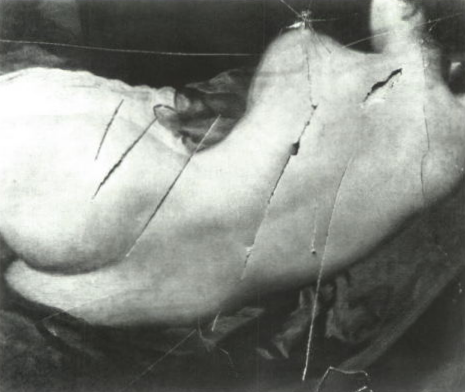 Ironically it didn't survive well the 20th century when in 1914, the militant suffragette and feminist Mary Richardson slashed Velásquez's masterpiece in protest of women's situation (see photograph).
This composition seems to unsettle many. The subject of my portrait has refused to "endorse" it. It will therefore remain anonymous.
Disabled artist Alison Lapper did create controversy when a statue of her naked body (born with short legs and no arms) was erected at Trafalgar Square in... 2005.

Thursday, 13 May 2010
Gold technique revisited

I am using a new technique: background partly painted in gold. Not as a gimmick but as an interesting way to make a portrait look more lively: its appearance changes depending on the angle we look at it. It cannot be shown here with a static pic. Sorry.

This is a traditional media which has been in practice for some 5,000 years, beginning in ancient India and was widely used during the great dynasties of ancient Egypt and spread in Eastern and Western Europe after the fall of the Roman empire (Byzantine icons and medieval altarpieces). Asia has also utilized gold-leaf backgrounds in their fine painting (see below: Heron- Song dynasty).

Gustav Klimt is the most famous European artist of the 20th century to have used gold leaf as a proper mode of his expression, away from its religious tradition in the West (see below: Klimt: the Kiss).
So, in the secular tradition revived by Klimt, I will use it more often as it adds a unique feature to a painting: being more alive and like "reacting" to our presence, from where we are and look.
Subscribe to:
Posts (Atom)